5 Top Best Tire Inflator with Gauge for Your Air Compressor Reviews
Keeping your tires properly inflated isn’t just about getting better gas mileage; it’s crucial for your safety on the road and extending the life of your tires. But let’s be real, driving to the gas station every time you need to top up isn’t exactly convenient. That’s where a reliable tire inflator with a built-in gauge for your air compressor comes into play, turning a chore into a quick, easy task right in your own garage.
If you’re wondering which model is the best tire inflator with gauge for my air compressor, you’ve come to the right place. We’ve dug deep to find the top contenders that offer accuracy, durability, and user-friendliness, ensuring you make an informed choice. No more guessing games or fiddling with separate gauges!
Why a Good Tire Inflator with Gauge Matters
Having an accurate tire pressure gauge and inflator hose attached directly to your air compressor makes tire maintenance a breeze. It allows you to check your tire PSI and adjust it on the fly, all with a single tool. This not only saves you time but also ensures that your vehicle’s tires are always at their optimal pressure, leading to:
- Enhanced Safety: Properly inflated tires offer better handling, braking, and stability, reducing the risk of blowouts or accidents.
- Improved Fuel Efficiency: Underinflated tires drag more, forcing your engine to work harder and consume more fuel.
- Extended Tire Lifespan: Evenly inflated tires wear more uniformly, meaning you won’t have to replace them as often.
- Convenience: No need to drive to a service station; handle your tire maintenance right at home.
Ready to upgrade your garage setup? Let’s dive into our top picks for the best tire inflator with gauge for my air compressor.
Our Top 5 Picks for the Best Tire Inflator with Gauge for Your Air Compressor
AstroAI Digital Tire Pressure Gauge with Inflator, 3-250 PSI
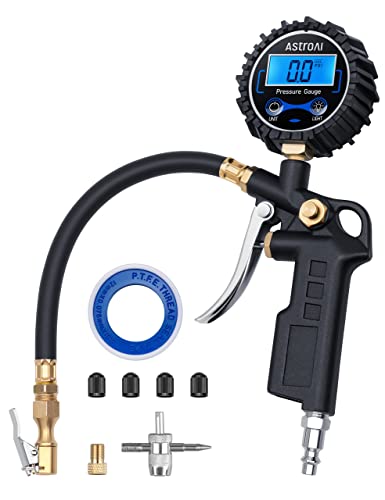
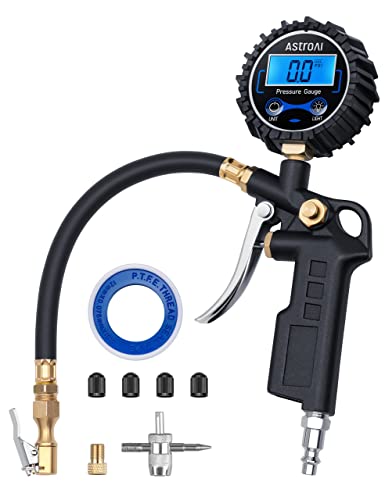
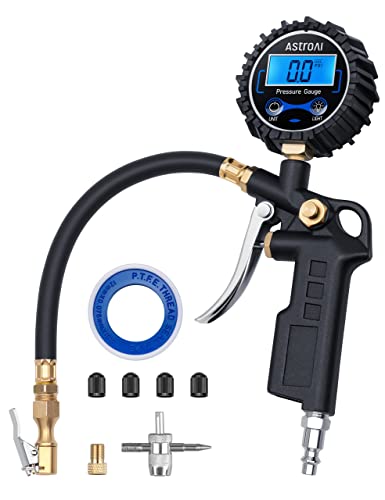
This AstroAI digital inflator truly stands out for its impressive versatility and precision. Designed to be compatible with both ¼” and ½” NPT air compressor outputs, it’s a solid choice for almost any home garage setup. What makes it a favorite is its robust construction and the fact that it combines inflation, deflation, and pressure checking into one seamless unit. If you’re looking for a heavy-duty, all-in-one solution that promises accuracy within 1%, this one’s definitely worth a look.
Key Features:
– Compatible with both ¼” and ½” NPT air compressors outputs and standard Schrader valves.
– Advanced accuracy within 1% of the exact pressure, measuring from 3-250 PSI.
– All-in-one unit includes straight locking chuck, gauge, hose, and bleed valve.
– Superior construction with heavy-duty stainless steel and high-quality brass components.
– Battery saver feature: automatic turn-on with pressure and turn-off after 20 seconds of inactivity.
Pros:
– Exceptional accuracy ensures reliable readings.
– Wide PSI range suitable for many vehicle types.
– Durable build quality for long-lasting performance.
– Versatile compatibility with various air compressor fittings.
– Convenient automatic on/off function saves battery.
Cons:
– Digital display might be less ideal for those who prefer mechanical gauges.
– Requires batteries, though it has a battery-saving feature.
User Impressions:
Users frequently praise this AstroAI inflator for its robust feel and spot-on accuracy, often mentioning how it makes quick work of tire maintenance. The all-in-one design and easy-to-read digital display are big hits, with many appreciating its reliability for everything from car tires to RVs.
AstroAI Digital Tire Pressure Gauge with Inflator (3-250 PSI, Four Units)
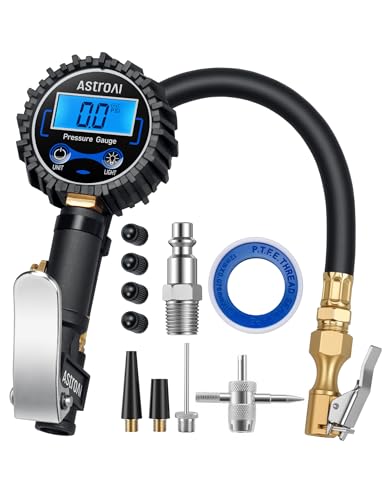
Another excellent offering from AstroAI, this digital tire inflator takes accuracy and user-friendliness to the next level by displaying readings in four different units. If you’re someone who deals with various vehicle types or just appreciates the flexibility of different measurement standards (PSI, KPA, Bar, and Kg/cm²), this model is a fantastic choice. It shares the same superior build quality and 1% accuracy as its sibling but adds that extra layer of convenience for a truly global user experience.
Key Features:
– Professionally calibrated for advanced accuracy within 1%, measuring from 3-250 PSI.
– Measures and displays in four different units: PSI, KPA, Bar, and Kg/cm².
– All-in-one unit with inflator, straight locking chuck, gauge, hose, and bleed valve.
– Built with high-quality, heavy-duty stainless steel and brass components.
– Automatic turn-on and turn-off after 20 seconds of inactivity to save battery life.
Pros:
– Multi-unit display is highly versatile for different applications.
– Excellent accuracy for precise tire pressure management.
– Durable construction ensures reliability.
– Integrated air bleeder valve for quick pressure adjustments.
– Suitable for a wide range of vehicles, including bicycles (with Schrader valve).
Cons:
– Still requires batteries, like most digital gauges.
– The distinction from the previous AstroAI model is primarily the multi-unit display.
User Impressions:
Customers love the clarity of the backlit LED screen and the ability to switch between units, making it incredibly adaptable. Many reviews highlight its consistent accuracy and the solid feel of the tool, affirming it as a trustworthy companion for routine tire checks.
CZC AUTO Tire Inflator Deflator Air Pressure Gauge with Large Dial

For those who prefer the rugged simplicity and reliability of a mechanical gauge, the CZC AUTO inflator is a top contender. This isn’t just a basic tool; it’s a premium 3-in-1 device featuring a large, easy-to-read dial (0-220 PSI) that requires no batteries – ever! Its surface-frosted aluminum handle and brass components scream durability. If you’re after a dependable, old-school feel with modern performance, and you want the best tire inflator with gauge for my air compressor that won’t die on you due to a dead battery, this might be your go-to.
Key Features:
– Complete 3-in-1 function: tests tire pressure, deflates, and inflates.
– Large 2-1/2″ mechanical dial gauge (0-220 PSI, 0-16kg/CM2) with gear-style rubber protector.
– No battery needed, ensuring constant readiness.
– Premium construction with surface-frosted aluminum handle and brass components.
– Calibrated to ANSI B40.1 Grade B (2%) international accuracy standard.
Pros:
– Mechanical gauge means no batteries to worry about.
– Large, clear dial is easy to read.
– Robust, heavy-duty construction built to last.
– Integrated inflator and deflator buttons for simple operation.
– Excellent for trucks, buses, RVs, and cars due to its higher PSI range.
Cons:
– Mechanical gauge might not offer the ultra-fine resolution of digital models.
– No backlight for use in dim conditions.
User Impressions:
Reviewers frequently commend its sturdy build and the straightforward, reliable readings of the mechanical gauge. The absence of batteries is a huge plus for many, who appreciate the peace of mind. It’s often praised for being a workhorse that stands up to regular use in various settings.
Spurtar 10-120 PSI Heavy Duty Tire Pressure Gauge with Dual Head Chuck

The Spurtar Heavy Duty Tire Pressure Gauge is a fantastic choice if you often find yourself wrestling with awkward valve stem angles, especially on dual-wheel setups or vehicles with recessed valves. Its standout feature is the ingenious dual-head chuck, allowing you to easily access inner and outer wheels or tricky spots. This mechanical gauge is built like a tank, making it a durable, reliable addition to your automotive tools. Plus, it comes with a handy set of extras like valve cores and caps – a nice bonus!
Key Features:
– Accurate mechanical gauge (10-120 PSI) calibrated to ANSI B40.1 Grade B (2%).
– Unique 5 11/16-inch chrome iron stem with push/pull dual head chuck for difficult angles.
– Bayonet-style inflation/deflation with an easy-to-read gauge.
– High-quality, heavy-duty chrome-plated cast steel iron stem and inflator.
– Multi-purpose use for a wide range of vehicles; includes accessories like valve cores and caps.
Pros:
– Dual-head chuck is incredibly convenient for hard-to-reach valve stems.
– Robust, heavy-duty construction ensures durability.
– No batteries required, always ready to go.
– Comes with useful accessories, adding extra value.
– Simple and straightforward to use for inflation and deflation.
Cons:
– Lower maximum PSI (120 PSI) might not be sufficient for all heavy-duty applications (e.g., some large RVs).
– Mechanical gauge lacks the precision and backlight of digital units.
User Impressions:
Customers frequently highlight the dual-head chuck as a game-changer for accessibility, particularly for larger vehicles or tricky valve placements. Its solid, heavy-duty feel inspires confidence, and many appreciate the included accessories as a thoughtful touch.
AZUNO Digital Tire Inflator with Pressure Gauge, 200 PSI

The AZUNO Digital Tire Inflator is for those who crave precision and a seamless user experience. With an incredible 0.1 PSI display resolution and robust engineering, it provides stable and accurate readings every time. What truly sets it apart is its single-handed operation – a simple trigger press inflates, and an air bleeder press deflates, with all changes instantly reflected on the bright, wide LCD screen. If you want a top-tier digital solution that’s easy to read and built for rugged shop use, this is a superb option.
Key Features:
– Accurate digital pressure gauge with 0.1 display resolution and 1% exact pressure reading.
– Easy single-handed operation for smooth inflation and deflation.
– Rugged engineering with highest quality steel and lasting brass components.
– Bright LCD backlight with auto on & off, displaying large numbers in 4 units (PSI, KPA, Bar, Kg/cm²).
– Suitable for a wide variety of tire sizes and vehicle types, including construction vehicles and large trucks.
Pros:
– Exceptional accuracy and high-resolution display (0.1 PSI).
– User-friendly single-handed operation simplifies tire adjustments.
– Extremely durable construction designed for heavy use.
– Clear, backlit LCD screen is easy to read in any light.
– Versatile with four measurement units and wide vehicle compatibility.
Cons:
– Requires batteries for the digital display and backlight.
– Might be considered overkill for very basic, infrequent use.
User Impressions:
Users are consistently impressed by the AZUNO’s precision and ease of use. The clear, backlit digital display makes reading pressure a breeze, even in low light, and the one-handed operation is a huge plus. Many describe it as a premium tool that feels solid and performs flawlessly for various vehicle types.
FAQ Section
Q1: Why do I need a tire inflator with a gauge for my air compressor?
A: A tire inflator with a built-in gauge combines three tools in one: a pressure gauge, an inflator nozzle, and often a deflator. This means you can quickly check your tire pressure, add or release air, and re-check, all with a single, convenient tool connected to your air compressor. It saves time, reduces clutter, and ensures consistent accuracy.
Q2: What’s the main difference between digital and analog (mechanical) gauges?
A:
* Digital Gauges typically offer higher precision (often to 0.1 PSI), are easier to read with backlit screens, and can display multiple units (PSI, KPA, Bar). They require batteries.
* Analog/Mechanical Gauges are robust, don’t require batteries, and are generally less susceptible to extreme temperatures or electronic malfunctions. They might offer slightly less precise readings (e.g., in 2 PSI increments) and lack backlighting. The choice often comes down to personal preference for precision versus simplicity and ruggedness.
Q3: How often should I check my tire pressure?
A: It’s recommended to check your tire pressure at least once a month, as well as before long trips. Tires can lose about 1 PSI per month naturally, and pressure also fluctuates with temperature changes (dropping in colder weather and rising in warmer weather). Always check pressure when tires are “cold” – meaning the car hasn’t been driven for at least three hours or more than a mile.
Q4: What PSI range should I look for in a tire inflator with a gauge?
A: The ideal PSI range depends on the types of vehicles you’ll be servicing. Most passenger cars typically require 30-35 PSI, while trucks, RVs, and some SUVs might need 40-80 PSI or even higher. A range of 0-100 PSI or 0-150 PSI is generally sufficient for most household needs, but if you have large trucks or RVs, look for gauges that go up to 200-250 PSI.
Q5: Can I use these tire inflators with any air compressor?
A: Most tire inflators are designed to connect to standard air compressors. The most common connection size is ¼” NPT (National Pipe Taper) for the air inlet. Some inflators, like the AstroAI models reviewed, also offer ½” NPT compatibility for larger compressors. Always check the product specifications to ensure it matches your compressor’s output fitting.
Q6: What’s an NPT fitting, and why does it matter?
A: NPT (National Pipe Taper) refers to a standard for tapered threads on pipes and fittings. It’s a common connection type for air tools and hoses. When choosing a tire inflator, you need to ensure its NPT fitting size (e.g., ¼” NPT) matches or is compatible with your air compressor’s output hose to ensure a secure, leak-free connection. Adaptors are available if the sizes don’t match exactly.
Q7: What features should I prioritize when choosing the best tire inflator with gauge for my air compressor?
A:
* Accuracy: Crucial for safety and tire longevity. Look for gauges calibrated to industry standards (e.g., ANSI B40.1 Grade B).
* Durability: Heavy-duty construction (brass, stainless steel, robust housing) ensures a long lifespan.
* Ease of Use: Ergonomic handle, clear display (digital or large dial), and simple inflation/deflation mechanism.
* Chuck Type: A good lock-on chuck or a dual-head chuck can make a big difference for convenience.
* PSI Range: Ensure it covers the maximum pressure for all your vehicles.
* Compatibility: Check NPT fitting size for your air compressor.
Q8: How do I know my tires are properly inflated?
A: Your vehicle’s recommended tire pressure (PSI) is usually listed on a sticker inside the driver’s side door jamb, in your owner’s manual, or sometimes on the tire’s sidewall (though the sidewall shows the maximum pressure, not necessarily the recommended pressure for your vehicle). Always follow the manufacturer’s recommended PSI for your specific vehicle and load.
Finding the best tire inflator with gauge for my air compressor doesn’t have to be a daunting task. By considering factors like accuracy, durability, ease of use, and compatibility with your air compressor, you can choose a tool that will make tire maintenance a breeze and keep you safer on the road. Whichever model you pick from our list, you’ll be investing in a reliable piece of equipment that will serve you well for years to come.